Bit Breakdown: Part 2
We’ve all been there, stacked tack rooms full of bits, hoping the next one will unlock our horse’s full potential. But no piece of hardware can replace true education. A horse may understand what we’re asking and still feel resistance; physically, mentally, or emotionally.
Being able to influence a horse’s body doesn’t mean they feel good doing it. They might be saying yes on the outside while fighting you inside. That’s why I love diving deep into anatomy, biomechanics, therapy, and all things related to building a horse that not only can but wants to perform.
The Mouthpiece
This is where feel meets function. It’s the part that goes inside the horse’s mouth and communicates your cues through the tongue, bars, lips, and palate.
Basic Rules:
Thicker = milder (pressure spread out)
Thinner = more precise (but harsher if misused)
More joints = more bend (ideal for stiff horses)
Fewer joints = more stability (ideal for over-bendy horses)
Some horses want flexibility. Others need boundaries. Some want tongue relief. Others hate ports. When you know what you’re trying to fix (too much bend, not enough bend, heavy on the front, bracing in the ribcage) you can choose the bit accordingly.
Also, the bit you use depends on what kind of rider you are. If you ride aggressive, you’ll need less bit. If you quiet, you’ll need more bit. Just becuse tou bought a horse running in an o ring doesn’t mean you will run it in one!
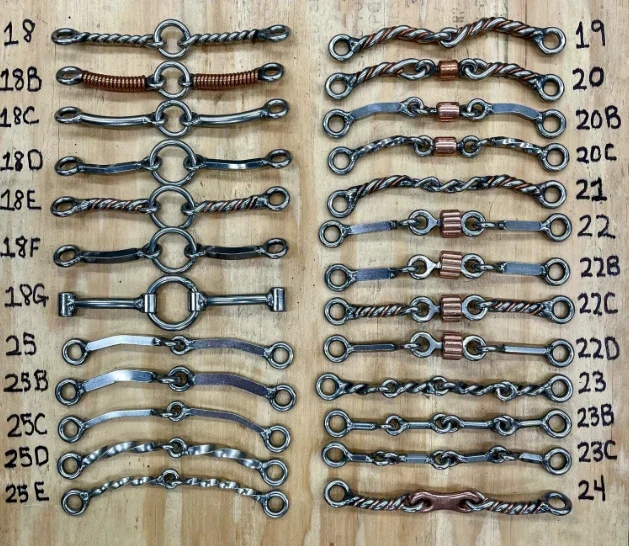
Chain
Soft and flexible, conforms to the horse’s tongue
Great for horses with low palates, large tongues, or past mouth trauma
Encourages bend, but can be harsh if yo-yo’d or jerky
Not ideal for heavy-handed riders
If you take a chain necklace or bracelet, you twist it one way, it will lock u. If you twist the other way, it will keep twisting up and balling up. When choosing a chain bit, make sure you’re getting one where the chain is “flipped” on the other half, usually with a ring or some piece in the middle.
2 Piece Smooth
Soft snaffle feel with less lateral independence
Great for building bendy confidence in green horses
If a horse prefers it, but needs more feel, consider bumping up to a twisted variation
2 Piece Twisted Wire
Classic “do-a-job” bit
Lays across the bars for shoulder lift and rate
Thin = sharper (⅜” gives more feel than ½”)
Great for horses that get pushy or brace
3 Piece Twisted Wire w/ oo center
More breaks = more lateral flexion
Twisted sides = more feel with less pressure
O-ring center reduces tongue pressure and spreads contact
Encourages soft bend without making them bracey
Smooth Bars w/ 3 chain center
Soft, forgiving, and very popular
Pressure is evenly distributed across the tongue
Prevents “nutcracker” effect that two piece mouthpieces can have
Great for young horses, older horses, or those needing a confidence boost
Square w/ 3 chain center
Square bars create sharper corners for clearer cues
Chain center keeps tongue relief and independent action
Stronger than smooth but still versatile
Smooth Port
Offers tongue relief and lift
Sides work independently
Great for horses who need more face control without adding anxiety
Twisted Wire Port
Twisted sides for added feel
Port for tongue control and collection
Keeps a horse from getting strung out in turns
Commonly paired with small gags or lifters
Large Square (3/8”)
Clear, direct message
For riders who need instant release and accountability
Not recommended for green riders
Small Square (1/4”)
Smaller diameter = more feel
For experienced riders needing subtle but firm communication
Not for timid hands
Mullen
Solid bar with a slight curve
Encourages poll lift and square shoulders
Perfect for horses that over-bend, get noodley, or lose structure in a turn
Excellent for collection-minded riding
Life Saver
A lifesaver mouthpiece is a three-piece bit with a round disc (like a candy lifesaver) in the center. It puts gentle, even pressure on the horse’s tongue and bars without the harsh “nutcracker” effect of a two-piece snaffle.
The disc helps:
Encourage softness and flexion
Improve lateral control
Increase salivation and comfort
It’s commonly used in O-rings, draw gags, and short shank bits for training or tuning. Great for horses that need more feel without more force.
Gags, Combos, and Set Up
Gag Bits: Apply pressure as reins slide before engaging. They create lift and delay, ideal for horses who need elevation and time to respond. Overuse or heavy hands can overwhelm sensitive horses.
Combo Bits: These combine gag action, shank leverage, noseband pressure, and curb engagement. They can control the face, encourage softness, and offer a layered signal. Must be used correctly or they can feel chaotic to the horse.
Setback curb adds power without overbending the nose
Hackamores: No mouthpiece, relys on nose and poll pressure. Great for horses with mouth injuries or dental issues. Fit is crucial: 3–4" above the nostrils, chin strap with two fingers of space.
Bridle Setup & Fit: Adjustments to headstall, curb strap, and rein setup impact the entire signal chain. A bad fit or too-tight noseband can turn a great bit into a nightmare.
Expert Opinions
Troy Flaharty
American-made steel and craftsmanship ensure balance and comfort.
Swept-back cheeks for delayed cues, straight cheeks for quicker reaction.
"There is no such thing as a severe bit—only severe hands."
J.D. Yates
Bit selection must match horse and rider.
Hackamores require precision fit to avoid damage or unclear pressure.
Recommends copper rollers and soft mouthpieces for nervous horses.
Dave Elliott
Advocates for balance and posture before pressure.
"Collection begins in the ribcage, not the mouth."
His custom bits emphasize anatomical comfort and timing.
Danyelle Campbell
Bit choice reflects a horse’s emotions, conformation, and experience.
Uses short shanks on broke horses; gags and combos for specific corrections.
Emphasizes body control, not face control.
Ed Wright
Famously used long-shanked pretzel bit on Misty for timing, not control.
Believes the horse’s feel and rate of response should guide bit choice.
Reinforces that bits don’t teach—riders do.
Final Thoughts
It’s tempting to believe the right bit will solve everything. But bits aren’t magic, they’re tools that magnify what you already have. Study your horse, refine your hands, and match your tack to your training. When in doubt, start with softness, and let your horse tell you what works.
There’s so many more mouthpieces I didn’t list, but if you want further explanation on one specifically, let me know!