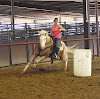
Vertical Flexion
You hear a lot of people say their horse is “soft” because they drop their head when asked. But for me, that’s extremely surface-level. Vertical flexion, true softness in the poll, isn’t about a horse looking broke. It’s about how they feel. And more importantly, it’s about how they hold that feel through every movement, not just in a circle, or at a trot with zero pressure.
Let’s break down exactly what vertical flexion means, why it matters, and when it shows up on the barrel pattern.
What is Vertical Flexion (Poll Softness)?
Vertical flexion is when the horse gives at the poll. But not just gives. When I talk about a horse being soft in the poll, I mean this:
Every time I ask, they give me more than I’m asking for.
That’s the gold standard. If I pick up my hand, I don’t want them to just put their head down and let me hold them there, I want them to offer more. To actually create slack in the rein on their own because they’re that in tune with the request. That’s vertical flexion.
And it needs to be consistent… no matter the shape, gait, or pressure. A horse that’s only soft when everything is easy isn’t really soft. Softness is proven in motion. In challenge. In the transitions.
Movements & Transitions Horses Need To Be Soft In
You don’t train softness in one maneuver and expect it to transfer. You’ve got to ask for it in everything. Here’s where I expect my horses to stay soft in the poll:
Gait Transitions-
Walk to Trot
Trot to Lope
Lope to Stop
Stop to Back
Back to Stop
Stop to Walk
Stop to Trot
Stop to Lope
Walk to Lope
Circles and straights at every gait
Rollbacks
Hip Controls
Shoulder Controls
Counter-Arc at all gaits
Straight Counter-Arc at all gaits
Where Vertical Softness Applies to the Pattern
Vertical flexion matters most right where your pattern starts to matter: the rate or collection point. That spot where the paths cross before the barrel? That’s where you should start asking for them to get soft, the “Prep” Point.
Right there, the horse has to(eventually):
Respond to your body and hand
Offer vertical flexion, more than what you ask for
Prep their body for the turn, whatever that means for them
Depending on the horse’s style and the setup, the prep spot might:
Collecting and slowing down (especially for free runners or turny horses)
Collecting and continuing forward (for push-style horses)
Getting balanced on The Tracks and engaged so they don’t fall into the turn or lose momentum
That move needs to eventually become automatic. When I start pulling at that prep point, I want them to respond with softness and readiness, without hesitation.
Why is Vertical Flexion Important?
Because softness doesn’t scale equally. You lose half when you move up into a run.
If your horse is only 50% soft at the lope, they’re gonna be 25% soft when you start running. 😅
So I aim for 100% softness at home. I want them to give more than I ask at the lope, at the walk, at the trot… so that when the adrenaline hits, I’ve still got something to work with.
And the Prep Point is where it all shows. That moment right before the turn? That’s your test. If they give it there, you’ve done your job.
Videos to come if y’all want to see it broken down even more!