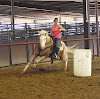
Train on the Tracks
If you’ve ever heard me say “stay on the tracks,” this is what I mean:
Imagine a set of train tracks drawn on the ground around the barrel, or around any path you’re asking your horse to follow. One rail for the left feet. One rail for the right feet. Wherever those rails go, the horse’s feet should follow: no drifting, no leaning, no throwing parts of their body off track.
This is body control. And it applies everywhere: circles, straight lines, warmups, slow work, full-speed runs. If your horse can’t stay on the tracks, they can’t stay balanced and square… and they can’t use their body right in a turn, at the rate point, or down the alley.
Staying on the tracks doesn’t mean they stay “stiff” in their body all the time. It means the body is in alignment and square with the path, whatever that path is. A circle still has bend, but both the left and right feet still have their own track to follow around that arc. The horse should stay between your reins and legs like they’re riding a set of rails.
And guess what? If something goes off the rails, the fix is probably one of your fundamentals:
What it means to stay on the tracks:
The shoulders shouldn’t drift out – If they do, use your outside rein to move them back in. That’s your shoulder control fundamental.
The hip shouldn’t swing out – If they’re crossfiring at a lope or drifting the hip off track, use your leg to move the hip back in. That’s your hip control fundamental.
The ribs should stay soft – If the horse is leaning in, or dropping into the turn, it’s probably time to go back to softening the ribs and reminding them to lift and stay between your legs. That’s your rib control fundamental.
How this shows up:
Circles – Are your horse’s shoulders staying on the circle? Are the hips following, or are they swinging out like a trailer in a sharp turn? Are the feet landing evenly around the arc, or is one side fading off the path?
Straight Lines – Can your horse lope straight without their body drifting? Without a fence? Are they leaning into one side, or do they stay straight and underneath you?
Prep Point – This is the moment where staying on the tracks matters most. As you approach the barrel and sit down to rate, your horse should:
Offer vertical flexion (soft in the poll)
Collect and drive their body underneath themselves
Keep both shoulders and hips on the track so they’re ready to turn—without swinging out or cutting in
Turns – If the shoulder drifts out or the hip fades, the turn becomes wide, choppy, or late. But if you’ve got them on the tracks, the turn becomes smooth and efficient, even if the horse’s style is different.
Bring it back to the Fundamentals
“Train on the Tracks” isn’t just a concept, it’s the natural next step after teaching the fundamentals.
You already taught your horse how to:
Move their hips
Move their shoulders
Stay soft in the ribs
Give vertically and laterally
Now, it’s time to expect them to hold that shape and stay in alignment with whatever path you put them on.
If they can’t hold the track, go back to the building blocks. Straight counter-arcs are a great way to check your work: can they tip their nose in toward your boot while staying perfectly straight line? Without a fence? If not, the hip’s probably drifting out. Fix it with the fundamentals.
This is how you train a horse thats truly broke.
It’s not just about flexion or softness… it’s about shape, balance, and direction all working together. The kind of horse that stays between your reins and legs, moves where you point them, and doesn’t fall apart the second you add pressure or speed.
That’s what “Train on the Tracks” really means.
Videos to come if y’all want to see it broken down even more.