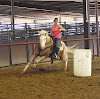
The Perfect Run
If you’ve ever wondered what separates the 1D runs from the rest, it’s not just a horse that’s soft and round. It’s not just about rate, or a pretty turn, or how broke they are. It’s about attention to detail, specifically, the path their feet take through every point of the turn.
I’m not just saying “hit your points” in a general sense. I’m talking about exactly where their feet need to land, especially the inside hind foot. If that foot hits the wrong spot, you either cut off the turn, blow past it, or make a wide ugly mess out of it. Horses won’t make perfect runs every time… because they’re horses. But this is the blueprint. This is the standard you’re aiming for.
Because if you can set them up to hit the perfect path, maybe one day you’ll clock the run you’ve always wanted. Not because it’s impossible, but because perfection itself is. The most flawless runs I’ve ever seen, from jockeys like Kassie Mowry or Ashley Schafer, still aren’t perfect. No animal, no human, no clock has ever seen an actual perfect run. But that’s why we practice it in our slow work, because if you aim for the impossible, you might just get close. And close is where the checks are.
What Makes the Perfect Run?
These points are marked by where the horse’s hip should pass… not their shoulder, not you, and not where their nose is. Each one sets up the next, and if you miss one, it shows up in your clock or your next turn. Let’s break it down by each barrrel.
First Barrel
Prep Point— The moment the tracks cross in front of the barrel. This is where you ask the horse to get ready, usually two-handed, just like asking for vertical flexion. Depending on the horse, this might mean they simply soften and keep driving forward, or they may need to rate down.
Point 1: One Hand— This is where you drop to the horn. You’re not turning yet, but you and the horse are ready. At this spot, you should be perpendicular to the fence in front of you.
Point 2: Turn— This is where the turn begins. If your horse is super turny or push-style, you may not need to do anything. But if you’re on a free-runner, this is likely where you pull. Aim your hand down and out toward the top of the barrel. Don’t pull back (you’ll kill forward momentum) and don’t lift up (you’ll hollow them out).
Neutral Zone (Backside)— Between points 2 and 3. Lay your hand on the neck, pull less, or cross over if needed, but do not pull toward the barrel. At this point, you and the horse should be parallel to the fence. This is the backside of the turn.
Point 3: Finish— When your horse’s hip reaches this spot (still parallel to the fence), you can cue them to finish the turn. Point with your hand to the next barrel, but keep it low and forward.
Point 4— The goal is to make a straight line from here to your second barrel prep point.
Second Barrel
Prep Point— Same concept as the first: this is where the horse needs to mentally and physically prepare for the turn. You’re still two-handed here. Ask for softness, rate if needed, and get them between your reins and legs.
Point 1: One Hand— Drop to one hand when you’re perpendicular to the fence in front of you.
Point 2: Turn— Start your turn. Some horses will initiate this on their own; others need help. Guide with a down and out hand, never back or up. Your goal is to keep them driving around the top of the barrel, not stalling out.
Neutral Zone (Backside)— Between points 2 and 3. Keep your hand quiet or lay it on the neck. This is the part where you let the horse work without accidentally pulling them into the barrel. You and the horse should be 𝗽𝗮𝗿𝗮𝗹𝗹𝗲𝗹 to the fence.
Point 3: Finish— Once the hip reaches this spot, cue them to finish the turn. Keep your hand low and point to the third barrel.
Point— Make a straight line from this point to your third barrel prep point.
Third Barrel
Prep Point— Same idea. This is your horse’s last chance to prepare. Soften, rate if needed, and make sure they’re collected before you release to one hand.
Point 1: One Hand— Drop to one hand when you’re perpendicular to the alley fence ahead.
Point 2: Turn— Begin the turn. Again, some horses won’t need much; others will need a clear pull. Hand should go down and out toward the top of the barrel, never back or up.
Neutral Zone (Backside)— Between points 2 and 3. Keep your hand soft and don’t pull toward the barrel. This is where horses most often get pulled in and hit a barrel if you’re not careful. Stay parallel to the fence.
Point 3: Finish— When the hip hits this final point, you can cue the turn to finish. Point your hand to the alley (not the sky!) and drive out.
Point 4— The goal is a straight line from here through the alley and across the timer line.
If You Miss a Point…
Don’t panic. Just line yourself up for the next prep point and keep moving forward. Don’t overcorrect or try to dive back to the barrel, that’s how you lose rhythm and hit one.
But this is where all your slow work and fundamentals matter: when things go wrong, your horse has to respond. If you’ve done the work, they’ll listen to your hands, your seat, your body, and you’ll be able to fix it on the fly. That’s why your foundation has to be perfect at all speeds, at every gait, for more than just one step. They have to be able to hold it.
Final Thoughts
That’s what the perfect run is made of. Not just being soft and round, not just hitting “about” the right spots, but placing the inside hind foot exactly where it needs to be, every time. That’s what shapes the turn, that’s what keeps your momentum, and that’s what wins checks.
It won’t always be perfect, but if you don’t know what perfect is supposed to feel like, you’ll never know how close you are. So train for the perfect run. Aim for it in your slow work. Teach your horse to hold their body on the track you choose.
Because perfection might be impossible, but clocking sure isn’t.